
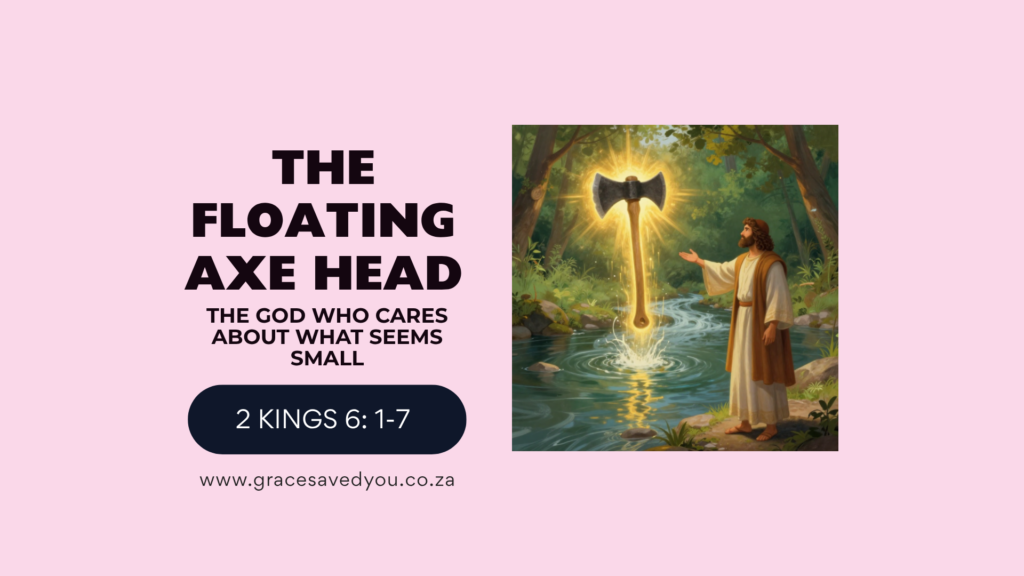
scripture focus : 2 Kings 6 : 1- 7
INTRODUCTION
- the Red Sea,
- fire from heaven,
- or Lazarus being raised from the dead.
- God’s compassion,
- His involvement in ordinary life,
- His supernatural power over impossibilities,
- His care for those walking faithfully in obedience.
Historical Background
Who is Elisha?
Yet even in a spiritually declining nation, God continued revealing His power and mercy through His prophet.
Geographical Setting
THE “SONS OF THE PROPHETS”
These were likely disciples under prophetic training, men committed to learning God’s Word, communities devoted to serving the Lord.
THE PROBLEM
This immediately became a crisis because iron was extremely valuable in the ancient world.Axes were expensive and difficult to replace.
This reveals responsibility, anxiety, humility, and likely financial inability. This man was probably poor and unable to repay the loss.
SPIRITUAL TRUTH
Sometimes the burdens that seem insignificant to others financial stress, emotional exhaustion, fear, small losses, daily struggles matter deeply to God.
WHY IS THIS MIRACLE IMPOSSIBLE?
- it sinks,
- disappears into muddy riverbeds,
- and is unrecoverable.
THE MIRACLE
WHY THE STICK?
Scripture does not explicitly explain why the stick was used, but many evangelical theologians see symbolic significance.The floating represents divine intervention where human effort fails.
“Not a single sparrow can fall to the ground without your Father knowing it…”
WHAT THIS REVEALS ABOUT GOD’S CHARACTER
1. God is compassionate. He cared about one man’s borrowed tool.
2. God is involved in ordinary life. Not every miracle happened before kings or crowds.Some happened quietly among faithful servants.
3. God values faithfulness.The prophets were working diligently when the miracle occurred.
4. God restores what seems unrecoverable.What sinks beyond human reach is still within God’s power.
Why the Jordan River is symbolically important in the Bible
- A place of crossing from old to new. Israel crossed the Jordan to enter the Promised Land
- A place of cleansing and renewal. Naaman was healed of leprosy in the Jordan (2 Kings 5)
- A place of spiritual rebirth. John the Baptist baptized in the Jordan (Matthew 3)
- A place where heaven breaks in. Jesus was baptized there, and the heavens opened (Matthew 3:16).
WHAT CAN WE LEARN TODAY?
1. Nothing is too small for God. If it matters to you,you can bring it to Him.
2. God often works quietly. Not every miracle is dramatic publicly. Some of the deepest miracles happen privately.
3. God cares about faithful servants. This man was simply doing the work before him.
4. God can restore what seems lost relationships, peace, joy, hope , direction, faith. What feels sunken beyond recovery is not beyond God.
5. Dependence invites God’s intervention. The man immediately cried out for help. This reflects humility and trust.
The miracle also confronts pride. Many people avoid bringing “small” concerns to God because they think, “This doesn’t matter enough.” , “God only cares about major crises.” but scripture reveals , God invites dependence in all things.
Reflection Questions
- Have I been carrying burdens I think are “too small” for God?
- Do I truly believe God cares about ordinary struggles?
- What in my life feels impossible to recover?
- Am I willing to depend on God daily instead of relying only on myself?
The floating axe head reminds us that God is not only Lord over great deliverances. He is also deeply present in the ordinary details of our lives.