
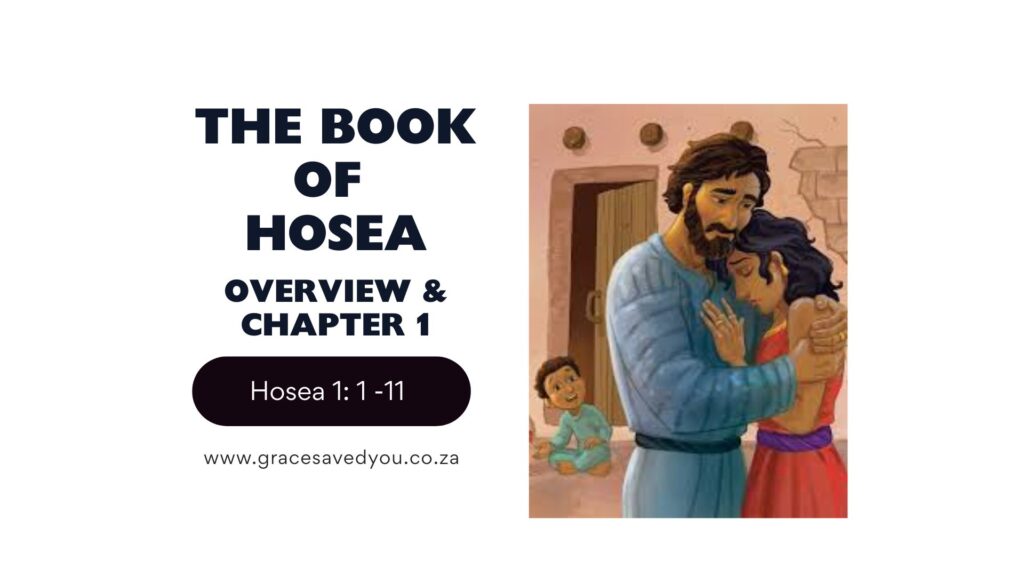
Scripture focus:
Hosea 1: 1- 11
Overview of the book of Hosea
Theme: Faithless Israel, Faithful God
1. Who Wrote the Book?
Author:
The book was written by Hosea, son of Beeri, a prophet called by God.
Meaning of Hosea:
“Hosea” means “salvation” or “help”, closely connected to the name Joshua / Jesus (YHWH saves)
2. When Was Hosea Written?
Time period:
Approximately 750–722 BC, during the reign of Jeroboam II in the Northern Kingdom of Israel
Historical setting:
- Israel was politically strong and economically prosperous
- Spiritually, however, the nation was deeply corrupt
- Idolatry was widespread, especially the worship of Baal
- God’s covenant was outwardly maintained but inwardly rejected
3. To Whom Was the Book Written?
Primary audience:
- The Northern Kingdom of Israel (Ephraim)
Secondary audience:
- Judah (the Southern Kingdom)
- God’s covenant people across generations
God speaks to a people who still used His name but no longer lived in faithfulness to Him.
4. The Central Message of Hosea
Israel’s Spiritual Adultery
- Israel is portrayed as an unfaithful wife, chasing other lovers (idols, false gods, political alliances)
God’s Covenant Love
- Despite Israel’s betrayal, God remains the faithful Husband disciplining, pursuing, and promising restoration.
This is not merely about sin; it is about broken relationship.
5. Hosea’s Marriage: Why Did God Command This?
God commanded Hosea to marry Gomer, a woman who would be unfaithful, to make visible what Israel had done spiritually.
- God was not endorsing sin
- God was revealing His heart
- Hosea felt what God felt
This reflects the gospel truth that God enters human suffering to redeem it, ultimately fulfilled in Christ.
6. The Children as Prophetic Signs
Each child’s name carried a message:
1. Jezreel – “God scatters”
- Judgment is coming
- Israel’s false security will collapse
2. Lo-Ruhamah – “Not loved / No mercy”
- Sin has consequences
- God’s mercy was being withdrawn temporarily
3. Lo-Ammi – “Not My people”
- Covenant rejection due to persistent rebellion
7. The Promise of Restoration
Right in the middle of judgment, God speaks hope:
“In the place where it was said to them, ‘You are not my people,’ they will be called ‘children of the living God.’” (Hosea 1:10)
- Quoted by Paul (Romans 9) and Peter (1 Peter 2:10)
- Fulfilled in Christ
- Applies to both Jews and Gentiles
This shows that Hosea ultimately points to salvation by grace.
8. What Was the Lesson for Israel?
- Prosperity does not equal God’s approval
- Religious activity without love is adultery
- God disciplines those He loves
- Repentance is relational, not transactional
- Restoration comes through returning to the Lord alone
9. Christ-Centered Conclusion
Hosea prepares us for Jesus:
- The faithful Bridegroom
- Who takes back the unfaithful bride (us sinners)
- At the cost of His own life
Chapter 1 Summary Explanation
Chapter 1 introduces both the prophet and God’s message, showing that the book is not only spoken by Hosea but lived through him. Hosea, whose name means “salvation” (from the same root as Joshua and Jesus), was a man chosen by God to speak His word faithfully into a time of deep spiritual decline. Though Hosea was an ordinary man with a wife and children, God used his life as a vessel to reveal divine truth. His message makes clear that salvation is found only by turning back to the LORD and away from sin.
Hosea ministered between 760–720 BC, during the reign of Jeroboam II in the Northern Kingdom of Israel. Politically and economically, Israel was prosperous, but spiritually the nation was corrupt, idolatrous, and morally decayed. The people no longer looked to God because life appeared stable. Yet beneath the surface, rebellion against the Lord was producing devastating consequences that would soon be revealed through national collapse, assassinations, and eventual exile.
God’s first word to Hosea was deeply personal: he was commanded to marry Gomer, a woman characterized by unfaithfulness. This difficult command was meant to mirror Israel’s spiritual adultery. Just as an unfaithful spouse wounds deeply, Israel’s idolatry grieved the heart of God. Hosea’s obedience placed him in a position where he would feel what God felt, rejection, betrayal, and heartbreak revealing that God is not distant or emotionless but personally invested in covenant relationship.
The children born to Hosea and Gomer carried prophetic names that spoke directly to Israel. Jezreel declared coming judgment and the end of Israel’s political power. Lo-Ruhamah (“No Mercy”) showed that persistent rebellion would lead to discipline. Lo-Ammi (“Not My People”) revealed the tragic reality that Israel had rejected their covenant identity. These were not merely punishments but honest declarations of what Israel had already chosen, a life apart from God.
Chapter 1 does not end in judgment. In a powerful reversal, God promises future restoration.
Those once called “not My people” will again be called “sons of the living God.” The divided kingdoms of Israel and Judah will be reunited, and the very names once associated with judgment will be redeemed. This restoration ultimately points forward to Christ, through whom God brings together Jews and Gentiles into one redeemed people.
Chapter 1 teaches that God disciplines because He loves, judgment is never His final word, and grace always has the last say. For believers today, it is a call to wholehearted faithfulness, a warning against comfortable spiritual compromise, and a reminder that no failure is beyond God’s power to redeem.